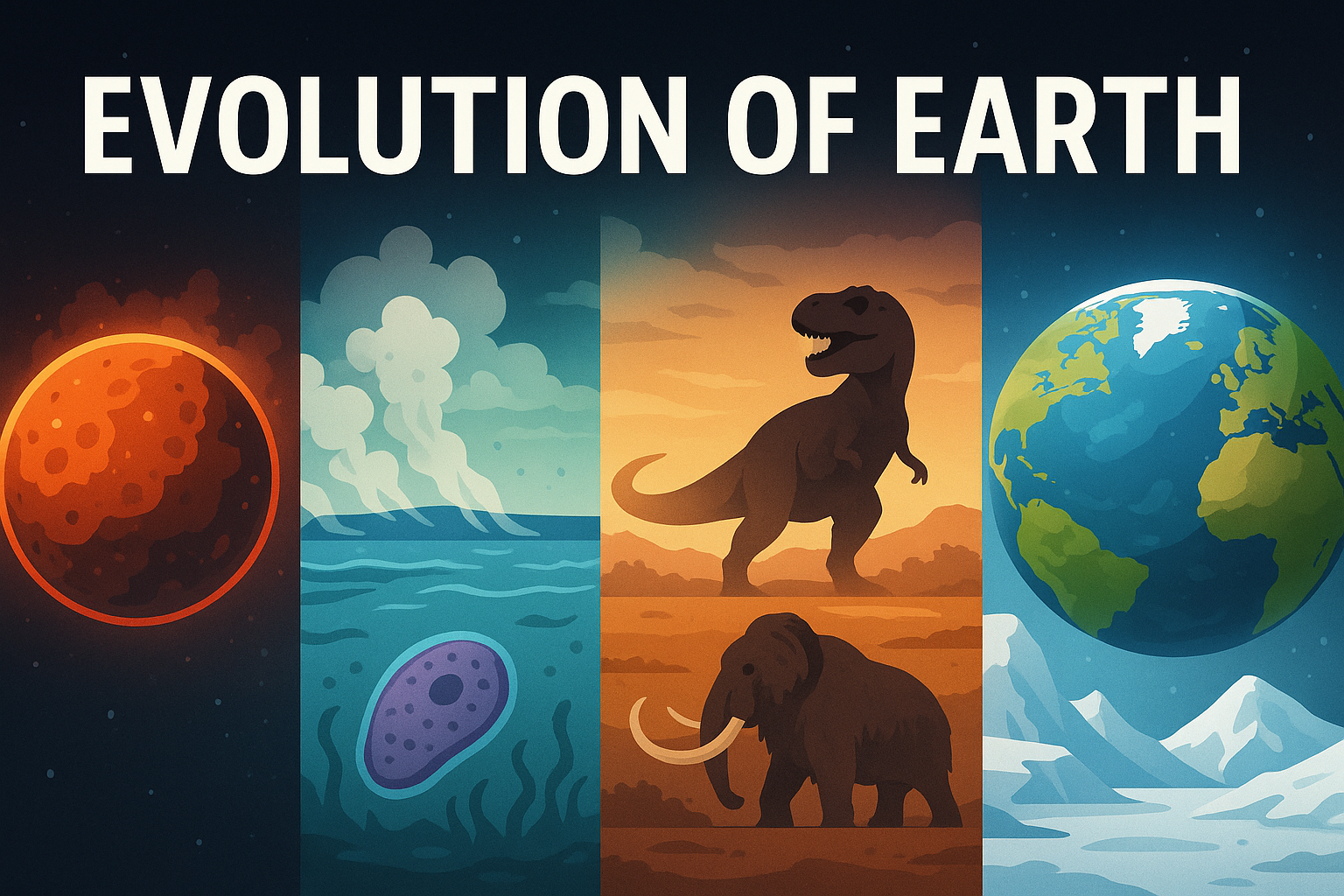
HISTORY OF EARTH AND EXTINCTION EVENTS
The Birth of the Universe and Earth
The Universe was formed around 13.8 billion years ago (1380 crore years), during the Big Bang — a singularity event that marked the beginning of time, space, and matter.
Our Earth came into existence much later, around 4.5 billion years ago (450 crore years), forming from the debris and dust surrounding the young Sun.
The Moon is believed to have formed from a colossal collision between early Earth and a Mars-sized body named Theia. The resulting debris eventually coalesced to form the Moon.
PRECAMBRIAN TIME
This spans most of Earth's history, from its formation to about 539 million years ago. Life started here, though very primitive and microscopic.
Hadean Period (Up to 400 crore years ago)
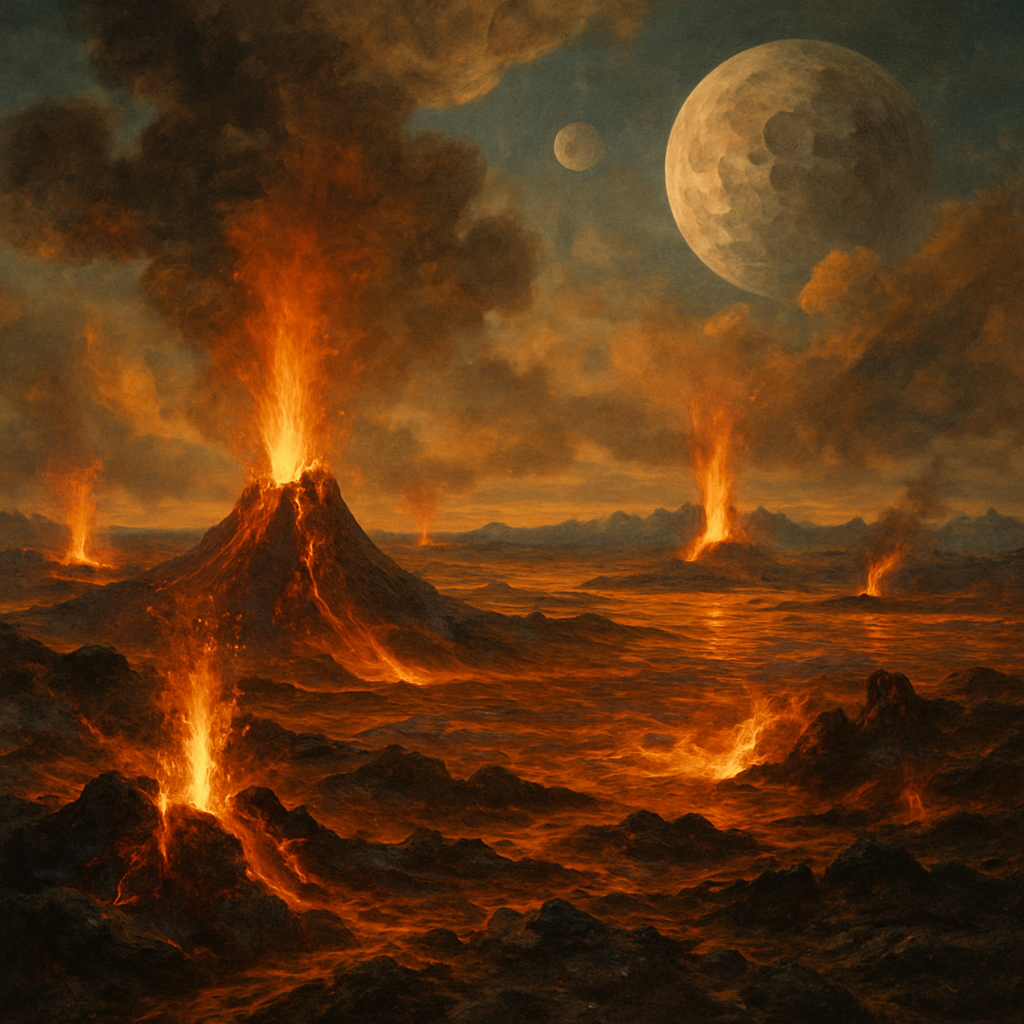
- Earth's surface was a hellish inferno, filled with molten rock, flowing lava, volcanic eruptions, and no solid crust.
- The atmosphere was toxic, filled with carbon dioxide (CO₂), nitrogen, sulfur, and no oxygen. It was unbreathable and incredibly hot.
- However, scientists have found ancient minerals like zircon crystals that suggest the presence of liquid water even during this early chaos.
- Frequent asteroid showers bombarded the Earth, possibly bringing essential elements or even water.
- The Sun was about 30% dimmer than today, yet Earth remained hot due to intense greenhouse gases.
- Named after Hades, the Greek god of the underworld, this period truly resembled hell.
Eoarchean (Up to 360 crore years ago)
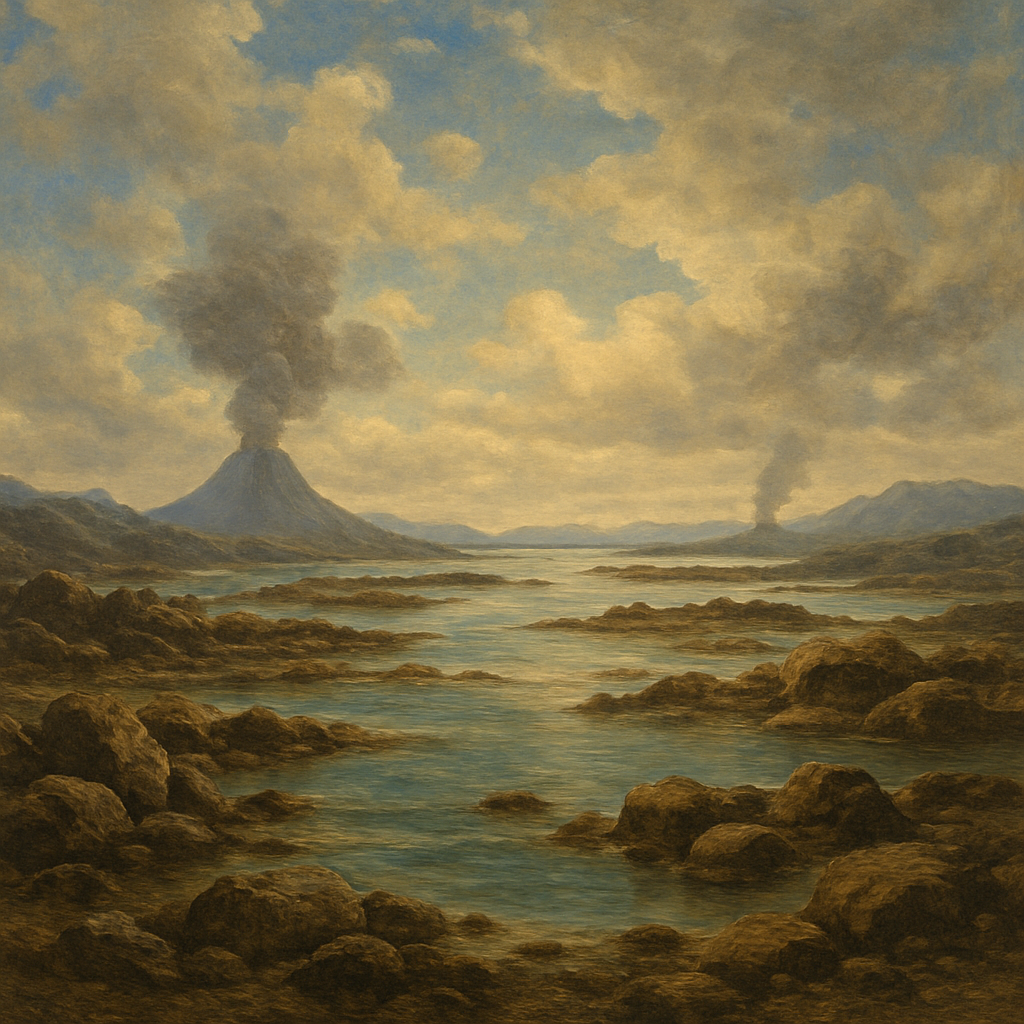
- Earth's surface began to cool. Heavy rain fell for millions of years, slowly forming the first oceans.
- Life may have originated here in deep-sea hydrothermal vents, where mineral-rich, boiling water provided the right environment for chemical reactions to build early life.
Paleoarchean (Up to 320 crore years ago)
- Most of the planet was covered by ocean, but hidden below, early supercontinents were beginning to form.
- We find the first clear evidence of life: Stromatolites — layered sedimentary rocks built by colonies of cyanobacteria.
- These cyanobacteria began to perform photosynthesis, slowly using sunlight to create food and releasing oxygen as a byproduct. Life was starting to "eat the Sun."
Mesoarchean (Up to 280 crore years ago)
- Continents started becoming visible. Plate tectonics caused landmasses to crash and shift.
- Oceans were extremely hot (over 40°C), and microbial life thrived in every corner.
- Without plants to consume CO₂, the atmosphere was packed with greenhouse gases. It was a lethal sauna for any modern life form.
- Still no oxygen to breathe — only microbial life existed.
Neoarchean (Up to 250 crore years ago)
- Earth was becoming more stable — temperatures were dropping slowly, and oceans had calmed.
- Around this time, more advanced prokaryotes (simple cells without nuclei) like bacteria started spreading.
- Still, life remained unicellular — tiny organisms in the vast oceans.
Proterozoic Eon: Where Things Change Slowly But Monumentally
Siderian (Up to 230 crore years ago)
- The Great Oxidation Event occurred.
- Cyanobacteria released so much oxygen that it flooded the atmosphere. But at first, this oxygen reacted with methane (a powerful greenhouse gas), turning it into CO₂ and water.
- This reduced greenhouse warming drastically and triggered the first global glaciation — Earth froze over in what's known as the Snowball Earth event.
- This ice age lasted millions of years and was devastating for many anaerobic life forms.
Rhyacian (Up to 205 crore years ago)
- Volcanic activity started melting the ice, warming the atmosphere with CO₂ again.
- This was a critical recovery period where the Earth slowly thawed.
Orosirian (Up to 180 crore years ago)
- A massive asteroid created the largest impact structure still known on Earth.
- Tectonic plates collided, creating huge mountain ranges and beginning the process of large-scale land formation.
Statherian (Up to 160 crore years ago)
- One of Earth’s first supercontinents, Columbia, formed by the merging of large landmasses.
Calymmian (Up to 140 crore years ago)
- A major moment in biological history: the first eukaryotic cells appeared — these had a nucleus and organelles.
- This happened when one cell engulfed another, creating a symbiotic relationship. These became the ancestors of all complex life, including plants, animals, and fungi.
Ectasian (Up to 120 crore years ago)
- Earth’s inner core began to solidify, forming a solid iron crystal at the center surrounded by molten metal.
- This improved Earth’s magnetic field, which helped protect life from harmful solar radiation.
Stenian (Up to 100 crore years ago)
- Sexual reproduction might have evolved here, thanks to red algae called Bangiomorpha pubescens.
- This led to genetic diversity, a powerful fuel for evolution.
Tonian (Up to 72 crore years ago)
- Prokaryotes and eukaryotes were in an evolutionary arms race.
- Life remained microscopic, and Earth was still quiet on the surface.
Cryogenian (Up to 63.5 crore years ago)
- Another Snowball Earth — one of the coldest periods in Earth’s history.
- Ice covered much of the planet again, but some microbes may have survived near hydrothermal vents.
Ediacaran (Up to 53.9 crore years ago)
- The supercontinent Gondwana was formed.
- Life suddenly became larger — the first multicellular organisms appeared, growing into visible sizes.
- This was the calm before a biological storm.
PALEOZOIC ERA: Life Takes Over
Cambrian (Up to 48.5 crore years ago)
- Cambrian Explosion: Life diversified explosively.
- Many major animal body plans appeared: arthropods, mollusks, early vertebrates.
- Plants started their journey onto land.
Ordovician (Up to 44.4 crore years ago)
- Rich marine biodiversity, but ended with a mass extinction, wiping out around 85% of species.
Silurian (Up to 41.9 crore years ago)
- Plants colonized land more widely.
- Soil began forming, and plants consumed large amounts of CO₂, altering the atmosphere.
Devonian (Up to 36 crore years ago)
- Age of fishes, first forests, and amphibians.
- Life was fully adapting to land environments.
Carboniferous (Up to 30 crore years ago)
- Giant forests, swamps, and insects ruled the Earth.
- Organic material from this era would eventually turn into coal, which we burn today.
- Oxygen levels were very high, supporting giant insects like dragonflies the size of birds.
Permian (Up to 25 crore years ago)
- Formation of Pangea, the last supercontinent.
- Ends with the biggest mass extinction in Earth's history — over 90% of marine species and 70% of terrestrial species vanished.
MESOZOIC ERA: The Age of Reptiles
Triassic (Up to 20 crore years ago)
- Dinosaurs emerged and began diversifying.
- Mammal-like reptiles also coexisted.
Jurassic (Up to 14.5 crore years ago)
- Dinosaurs dominated land.
- First birds appeared — evolved from feathered dinosaurs.
- Warm and humid climate.
Cretaceous (Up to 6.6 crore years ago)
- Flowering plants evolved.
- Dinosaurs flourished until a massive asteroid impact near modern-day Mexico caused the Cretaceous-Paleogene extinction.
CENOZOIC ERA: The Age of Mammals
Paleogene (Up to 2.3 crore years ago)
- Mammals diversified rapidly, taking over many ecological roles.
- Continents began shifting into modern positions.
- First primates evolved.
Quaternary (2.3 crore years ago – Present)
- Marked by multiple ice ages and the rise of humans.
- Homo sapiens emerged around 3 lakh years ago, transforming the planet through culture, agriculture, and technology.
THE BIG FIVE MASS EXTINCTIONS
Each of these events wiped out a huge percentage of Earth's life, reshaped ecosystems, and opened the door for new forms of life to evolve.
1. End-Ordovician Extinction
- Around 444 million years ago
- Species lost: ~85% of marine species
- Life at the time: Mostly in the oceans — trilobites, corals, and brachiopods were dominant.
Cause:
A sudden ice age likely triggered by the uplift of the Appalachian Mountains and weathering of silicate rocks, which pulled CO₂ from the atmosphere.
Massive glaciation caused sea levels to drop, eliminating shallow marine habitats.
Impact:
The first major extinction event.
Heavily affected reef-building organisms and shallow-water marine communities.
Life rebounded over millions of years as the climate warmed again.
2. Late Devonian Extinction
- Around 360–375 million years ago
- Species lost: ~75% of marine species
- Life at the time: Coral reefs were thriving, early fish were diversifying, and the first forests were appearing.
Causes (multiple and debated):
- Widespread anoxia (lack of oxygen) in oceans due to decaying plants and nutrient runoff.
- Massive plant growth on land changed soil and atmospheric chemistry.
- Possibly triggered by asteroid impacts or volcanic eruptions.
Impact:
Coral reefs collapsed and disappeared for 100 million years.
Devastated marine life, especially jawless fish and reef dwellers.
Land plants and insects survived relatively well.
Recovery was slow and gradual.
3. End-Permian Extinction ("The Great Dying")
- Around 252 million years ago
- Species lost: ~96% of marine species, ~70% of terrestrial vertebrates
- Life at the time: A mix of advanced marine life (ammonites, trilobites) and early land reptiles and plants.
Cause:
- Catastrophic volcanic eruptions in Siberia (Siberian Traps) released massive amounts of CO₂ and methane.
- Triggered runaway global warming, acid rain, and ocean acidification.
- Oxygen levels in the ocean plummeted, killing marine life.
- Global temperatures rose ~8°C.
⚠️ Impact:
Most severe extinction in Earth's history.
Entire groups like trilobites vanished forever.
Ecosystems collapsed; it took over 10 million years to fully recover.
Paved the way for the rise of dinosaurs and new life forms in the Triassic.
4. End-Triassic Extinction
- Around 200 million years ago
- Species lost: ~80% of species
- Life at the time: Marine reptiles, amphibians, early dinosaurs, and conifer forests.
Cause:
Volcanic activity from the break-up of the supercontinent Pangaea (Central Atlantic Magmatic Province).
Released massive greenhouse gases like CO₂ → rapid climate warming and ocean acidification.
Impact:
Many large amphibians and reptiles went extinct.
Dinosaurs survived and rapidly diversified, dominating the Jurassic era.
Modern coral reef systems eventually appeared in the aftermath.
5. End-Cretaceous Extinction (K-Pg Event)
- Around 66 million years ago
- Species lost: ~75% of species
- Life at the time: Dinosaurs ruled the land, seas full of marine reptiles, ammonites, and primitive mammals.
Cause:
- A 10 km-wide asteroid struck the Yucatán Peninsula (Chicxulub crater in Mexico).
- Created massive shockwaves, wildfires, global darkness from atmospheric dust, and nuclear winter-like conditions.
- Possible contribution from volcanic eruptions in India (Deccan Traps).
Impact:
All non-avian dinosaurs went extinct.
Many marine reptiles, ammonites, and plants also disappeared.
Mammals survived and diversified, eventually leading to primates and humans.