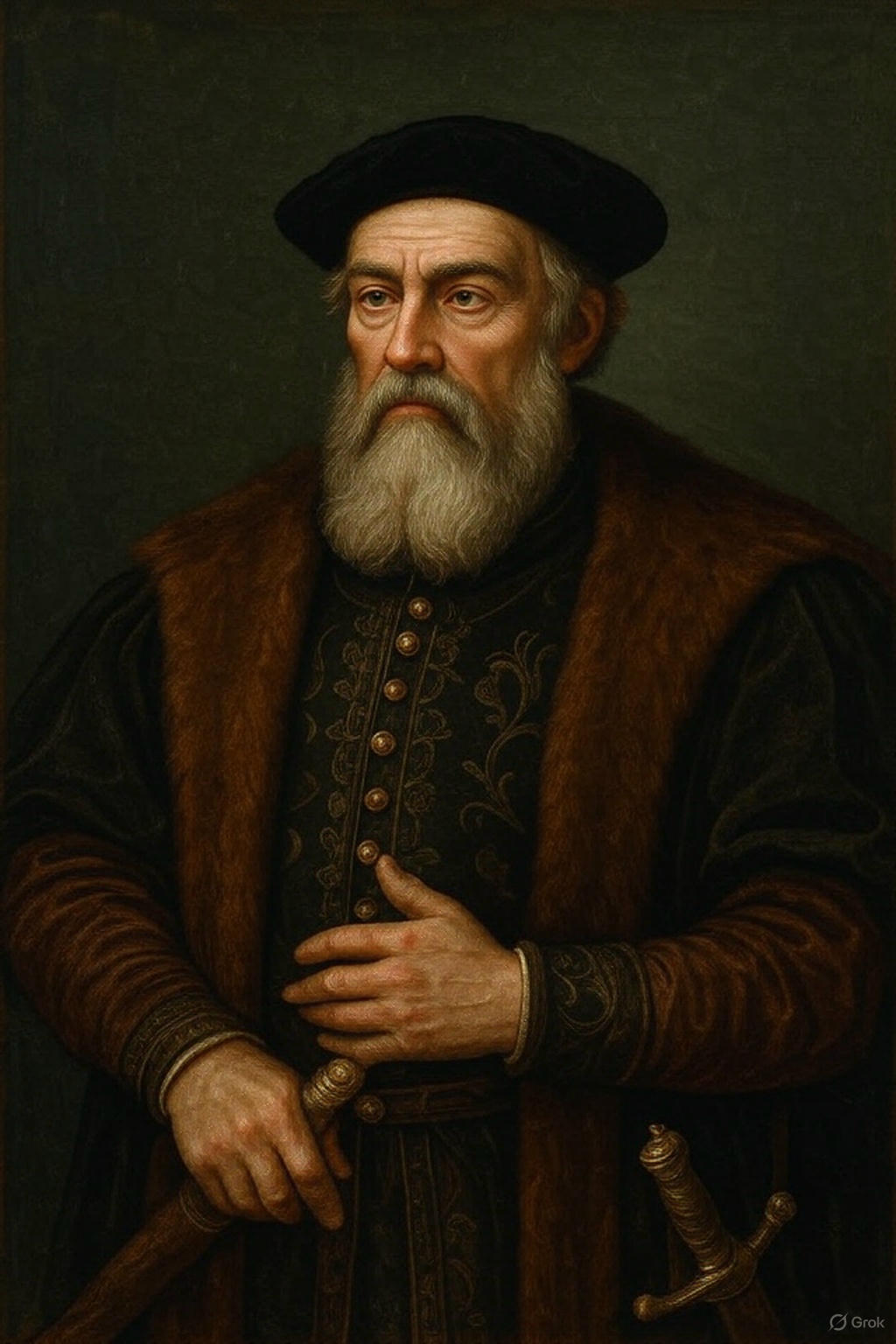
10. Francisco de Almeida – The First Viceroy of Portuguese India (1505–1509)
Why Was He Sent?
- By 1505, Portugal wanted more than just trade — they wanted a permanent empire in the East.
- Recognizing the need for permanent control, King Manuel I appointed Francisco de Almeida as the first Viceroy of Portuguese India in 1505.
Almeida arrived with a vision — the "Blue Water Policy":
- Focus on dominating the sea, not conquering land,
- Use a strong navy to protect Portuguese trade,
- Build forts at key coastal locations to defend Portuguese interests.
Key Achievements of Francisco de Almeida
1. Building Fortresses:
- Almeida established and strengthened forts at:
- Cochin,
- Cannanore,
- Anjediva Island.
These forts acted as Portuguese strongholds along India's western coastline.
2. Introduction of the Cartaz System:
- To enforce Portuguese control over the sea, Almeida introduced the Cartaz system:
- All merchant ships sailing the Indian Ocean had to buy a Cartaz pass from the Portuguese.
- The pass listed where the ship could go and what it could carry.
- Ships without a Cartaz risked being captured, taxed heavily, or sunk by Portuguese patrols.
This system allowed the Portuguese to:
- Control sea trade without conquering large inland areas,
- Weaken rival traders, especially Muslim merchants,
- Collect revenue through taxes on merchant ships.
3. Battle of Diu (1509):
In 1509, Almeida’s power was tested when a strong alliance of Arab, Egyptian, and Indian forces tried to break Portuguese control.
At the Battle of Diu, Almeida led the Portuguese fleet to a decisive victory:
- The enemies were crushed,
- Portuguese naval dominance over the Indian Ocean was firmly established,
- Muslim maritime power in the region was significantly weakened.
This battle marked the true beginning of European domination of Asian seas.
4. Personal Tragedy:
During his tenure, Almeida’s son, Lourenço de Almeida, was killed in battle near Chaul by the Egyptian navy.
This personal loss is believed to have hardened Almeida’s resolve to destroy Portugal’s enemies completely.
End of Almeida’s Rule
After his successes, Almeida was ordered to return to Portugal in 1509. He reluctantly handed over power to Afonso de Albuquerque, his successor.
On his journey back, Almeida was tragically killed by local tribes at Saldanha Bay (South Africa) in 1510.
Legacy of Francisco de Almeida
- Introduced Cartaz system that controlled sea trade,
- Established the Blue Water Policy focusing on naval power,
- Won the Battle of Diu, ensuring Portuguese supremacy,
- Laid the foundation for the Portuguese Empire in Asia.
His policies allowed Portugal to control vital trade routes between India, Africa, Arabia, and Europe, setting the stage for a century of Portuguese dominance.