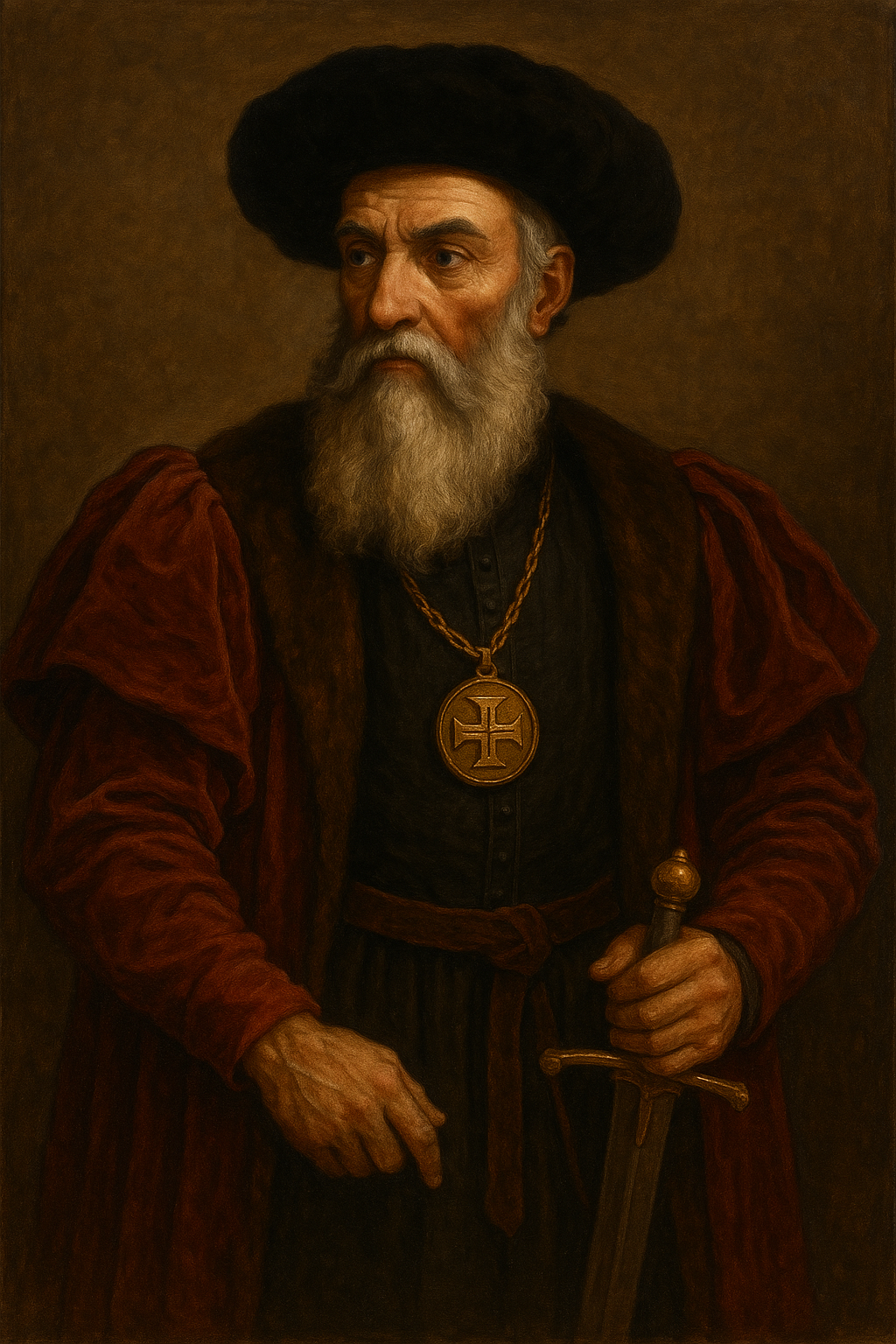
11. Afonso de Albuquerque: The Architect of the Portuguese Empire in Asia
Arrival in India
After Francisco de Almeida's departure in 1509, Afonso de Albuquerque was appointed the new governor of Portuguese India.
Unlike Almeida, who focused mainly on sea power, Albuquerque believed that the Portuguese should also control important coastal territories to strengthen their hold permanently.
Albuquerque was a brilliant military strategist, often called the "Founder of the Portuguese Empire in the East" because of his bold and successful actions.
His main goals were:
- Control key trade routes in the Indian Ocean,
- Capture important coastal cities,
- Disrupt Muslim trade networks (especially between India and the Middle East),
- Spread Christianity,
- Create a permanent Portuguese presence in Asia.
Major Achievements of Afonso de Albuquerque
1. Conquest of Goa (1510)
In 1510, Albuquerque led a daring expedition to capture Goa, which was under the control of the Bijapur Sultanate.
- Goa was a rich port city with a strategic location on the western coast of India.
- Albuquerque first captured it but had to retreat temporarily.
- He returned with reinforcements and recaptured Goa successfully.
- Goa became the headquarters of Portuguese India and remained under Portuguese control for more than 450 years (until 1961!).
Goa's Importance:
- A major trading hub,
- Gave the Portuguese a strong base for operations in India,
- Became the center for Portuguese administration, trade, and missionary activities.
"Goa is the very heart of Portuguese India." – said later historians.
2. Capture of Malacca (1511)
Albuquerque’s ambition was not limited to India.
He realized that controlling trade to China and the Spice Islands (modern Indonesia) required controlling Malacca, a vital port city in Southeast Asia.
- In 1511, Albuquerque led a surprise attack on Malacca,
- Defeated the local Sultan’s forces,
- Captured the city,
- Established a Portuguese fortress there.
Malacca's Importance:
- Controlled the narrow strait between the Malay Peninsula and Sumatra (now called the Straits of Malacca),
- Essential for trade between India, China, Japan, and the Spice Islands.
3. Attempt to Capture Aden and Red Sea Control
Albuquerque also planned to capture Aden at the mouth of the Red Sea, aiming to cut off Muslim trade between India and the Middle East.
Although he failed to capture Aden, his attempts showed how ambitious and strategic he was — thinking beyond India to the wider Indian Ocean world.
He even dreamed of conquering Mecca and controlling the Islamic holy lands to completely weaken Muslim powers in Asia!
4. Establishment of Portuguese Power and Policies
- Encouraged Portuguese soldiers to settle in India by marrying local women (creating a mixed Portuguese-Indian community),
- Allowed freedom of religion for Hindus,
- Focused on building strong fortresses along the coast,
- Made Goa a vibrant trading and administrative center.
Albuquerque's approach was not just about military conquest — he wanted the Portuguese to blend into the local culture and build a lasting empire.
Death and Legacy
Afonso de Albuquerque died in 1515 near Goa, feeling betrayed by the Portuguese king, who recalled him in favor of another officer.
However, his legacy was enormous:
- He built the foundation of the Portuguese Empire in Asia,
- Secured Portuguese domination over key ports and trade routes,
- Changed the course of Asian-European relations forever.
Even today, he is remembered as one of the greatest empire builders of all time.
In short, without Albuquerque’s leadership, the Portuguese presence in India would have remained small and temporary — it was he who turned it into a mighty and lasting empire.
Summary of Albuquerque’s Major Actions
| Year | Event |
|---|---|
| 1510 | Captured Goa |
| 1511 | Captured Malacca |
| 1513 | Attempted to capture Aden |
| 1515 | Death near Goa |